

_1793775451_WNo_1600d900.webp)
Are you looking for reliable filling and sealing machine manufacturers for food, beverage, pharmaceutical, cosmetic, or daily chemical production? Do you need equipment that can accurately fill different products and create consistent, hygienic seals? Or are you looking for a manufacturer that can customize a complete packaging solution around your container type, production capacity, and processing requirements?
If the answer is yes, then choosing the right equipment supplier is an important step toward improving packaging efficiency and product consistency. The global market includes manufacturers specializing in cup and tray filling-sealing systems, liquid bottle filling and capping lines, tube filling machines, and aseptic blow-fill-seal equipment. This guide compares 10 manufacturers and their main capabilities to help buyers identify suitable equipment partners.
Quick Navigation
- Ampack
- ORICS Industries
- Yijianuo
- Rocket Machine Works
- Serac
- Weiler Engineering – ASEP-TECH
- Fogg Filler
- Modern Packaging
- APACKS
- Wabash Equipment
- Filling and Sealing Machine Price Factors
- How to Choose a Manufacturer
- FAQs
1. Ampack
Headquarters / Supply Model: Ampack is a packaging machinery manufacturer based in Königsbrunn, Germany. The company states that it has developed, designed, and manufactured filling and sealing machines since 1973 and supplies equipment to international markets.
Core Products / Technologies: Ampack specializes in hygienic filling and packaging machinery for liquid and viscous food products. Its portfolio includes cup filling machines, bottle filling machines, and aseptic thermoforming equipment. Applications include dairy and plant-based products, desserts, drinks, baby food, clinical nutrition, and delicatessen products. Its published range includes FCL and LFS cup filling machines, TFA thermoforming equipment, and FBL bottle filling machines.
Why Consider Ampack: Ampack is relevant to buyers who need hygienic or aseptic filling processes rather than basic filling and closing equipment. Its experience in dairy, clinical nutrition, and other sensitive food applications makes it worth evaluating when product protection, packaging hygiene, and production consistency are important.
Best Suited For: Dairy processors, plant-based food manufacturers, baby food producers, clinical nutrition companies, and beverage businesses seeking industrial cup or bottle filling systems.
Before Purchasing: Confirm the required hygiene level, product characteristics, container material, filling volume, and target output. For aseptic projects, ask about sterilization methods, CIP/SIP arrangements, process validation, installation, operator training, and service support.
2. ORICS Industries
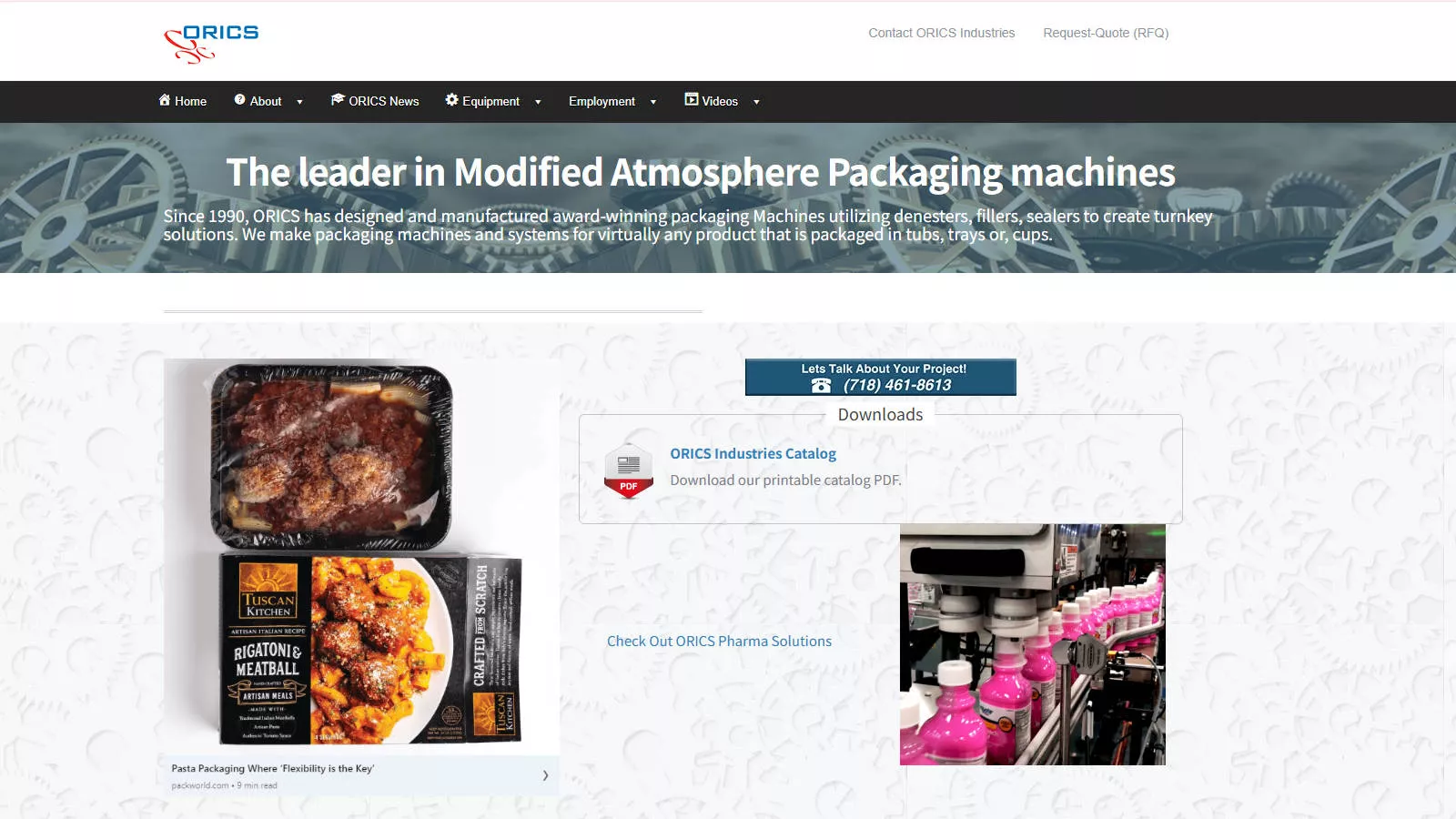
Headquarters / Supply Model: ORICS Industries designs and manufactures packaging machinery in Farmingdale, New York, USA. The company has focused on food and pharmaceutical packaging equipment since 1990 and offers individual machines as well as customized packaging lines.
Core Products / Technologies: ORICS manufactures cup filling and sealing machines, tray filling and sealing systems, denesting equipment, heat sealing equipment, and form-fill-seal machinery. Its range includes manual and automatic equipment, as well as systems using Modified Atmosphere Packaging (MAP) technology. The company also offers conveying, capping, and packaging-line integration solutions.
Why Consider ORICS Industries: ORICS focuses on cup and tray packaging rather than general-purpose liquid bottling alone. Its equipment can support products packed in cups, tubs, trays, and other suitable containers. Buyers can evaluate its systems for applications requiring denesting, filling, gas flushing, heat sealing, and downstream handling.
Best Suited For: Food processors handling fresh produce, meat, poultry, seafood, dairy, deli products, ready meals, and institutional food packaging.
Before Purchasing: Determine whether the application needs MAP gas flushing or conventional sealing. Provide container drawings, packaging material, product characteristics, and target line speed. Confirm whether denesting, filling, conveying, sealing, and discharge are included in the proposed system.
3. Yijianuo
Headquarters / Supply Model: Wuhan Yijianuo Machinery Co., Ltd. is a packaging machinery manufacturer based in Wuhan, Hubei, China. The company states that it was established in 2012 and operates a production base covering approximately 10,000 square meters, with more than 120 employees. Its business includes machinery research and development, design, manufacturing, sales, and after-sales support.
Core Products / Technologies: Yijianuo's filling and sealing machines are designed for pre-made containers such as cups, trays, boxes, and bowls. Depending on the machine and filling system, equipment can handle liquid, viscous, paste, powder, or particulate products. Published examples include yogurt cup filling and sealing machines, beverage cup filling systems, aluminum foil tray filling and sealing machines, vacuum tray sealing equipment, and food bowl sealing machines. The company also supplies filling and capping machines, automatic packaging lines, and thermoforming packaging equipment.
Why Consider Yijianuo: Yijianuo is worth considering for buyers who need filling and sealing equipment for multiple pre-formed container styles. Its product range covers cups, bowls, boxes, and trays for different food packaging applications. The company also describes customized machine development and integrated processes involving container loading, filling, sealing, and finished-product discharge.
Best Suited For: Food and beverage manufacturers, prepared-meal producers, sauce and condiment businesses, dairy processors, pet food manufacturers, and companies packaging products in cups, bowls, boxes, or trays.
Before Purchasing: Confirm container dimensions, material, sealing-film type, product viscosity, particle size, filling accuracy, and required output. Ask about vacuuming or nitrogen flushing if needed, and request a sample packaging test, machine layout, changeover details, cleaning procedures, and after-sales service terms.
4. Rocket Machine Works
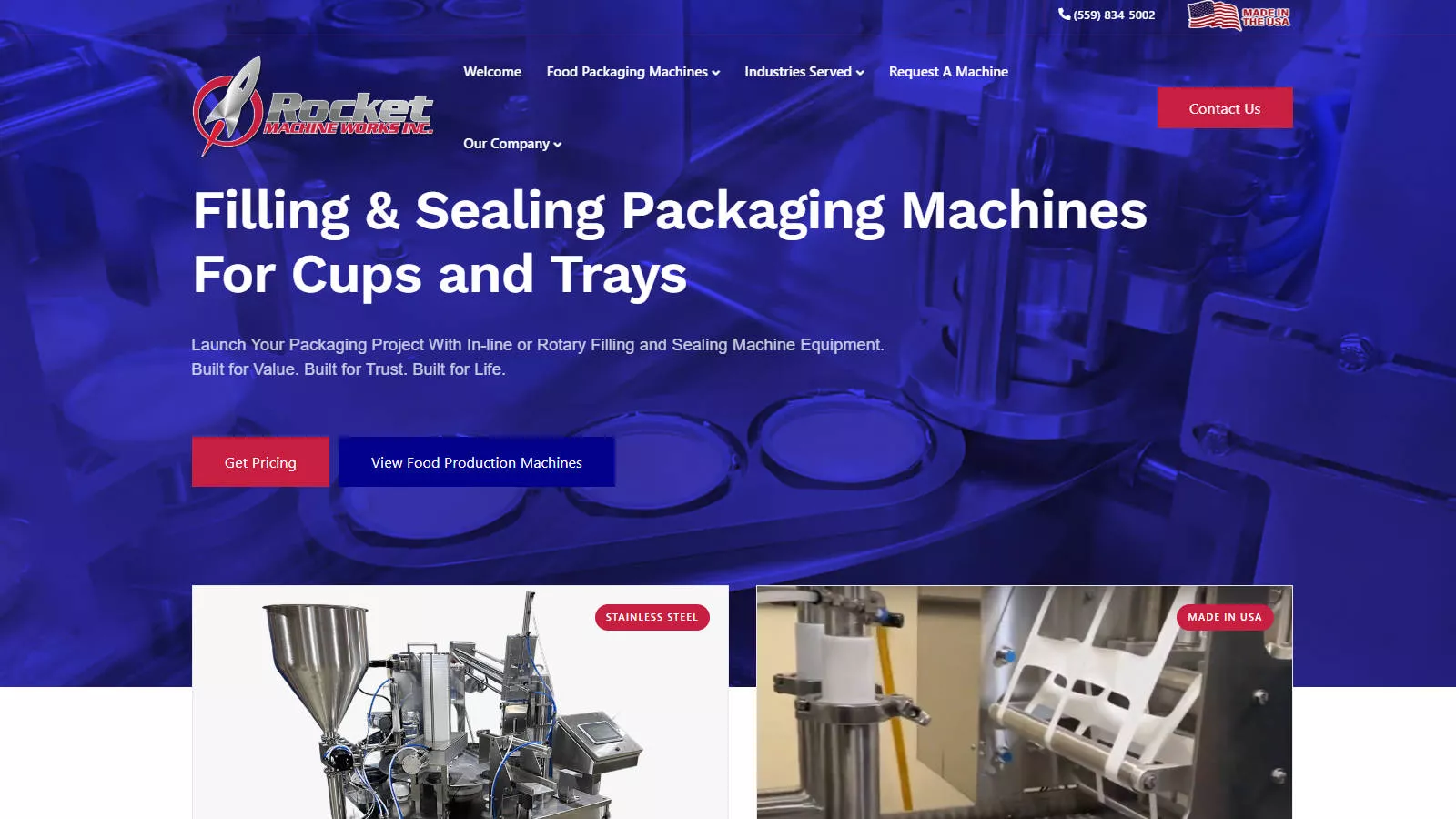
Headquarters / Supply Model: Rocket Machine Works, Inc. is a custom packaging machinery manufacturer located in Fresno, California, USA. The company describes itself as a full-service manufacturing facility, with machines engineered, manufactured, and assembled in-house.
Core Products / Technologies: Rocket Machine Works builds rotary and inline filling and sealing machines for cups, trays, clamshells, cans, jars, tubs, canisters, punnets, and bottles. Its equipment can be designed for hot or cold products. The company also supplies tray sealing machines, conveyors, accumulators, off-loaders, and other packaging-line components, along with rebuilding and retrofitting services.
Why Consider Rocket Machine Works: Its main advantage is its custom-engineering and in-house manufacturing approach. The company develops equipment for different food packaging formats, with rotary and inline configurations that buyers can evaluate according to production flow, available floor space, and output requirements.
Best Suited For: Food processors, prepared-food manufacturers, fresh-food packers, and businesses needing custom filling and sealing machinery for cups, trays, tubs, or other containers.
Before Purchasing: Provide container samples, product temperature, filling characteristics, packaging material, and target output. Confirm the filling and sealing sequence, tooling, changeover time, cleaning requirements, and integration with upstream or downstream equipment.
5. Serac
Headquarters / Supply Model: Serac is an international packaging machinery manufacturer with a long-standing focus on filling and capping technologies. It develops packaging equipment for food, beverage, household, personal care, paint, and lubricant markets.
Core Products / Technologies: Serac's portfolio includes filling and capping machines for liquid and viscous products in bottles. Its published range includes semi-automatic, ultra-clean, rotary, anti-corrosion, and aseptic filling and capping solutions.
Why Consider Serac: Serac is relevant to buyers whose packaging process requires bottle filling followed by cap or closure application. Its product range addresses different liquid characteristics and operating environments, including chilled beverages, corrosive products, and aseptic filling applications.
Best Suited For: Dairy and beverage producers, edible-oil manufacturers, sauce processors, household and personal-care product companies, and manufacturers handling liquid or viscous products in bottles.
Before Purchasing: Confirm product viscosity, chemical compatibility, bottle material, dimensions, cap type, and output. For aseptic or ultra-clean equipment, request details about process design, cleaning procedures, validation responsibilities, and line integration.
6. Weiler Engineering – ASEP-TECH
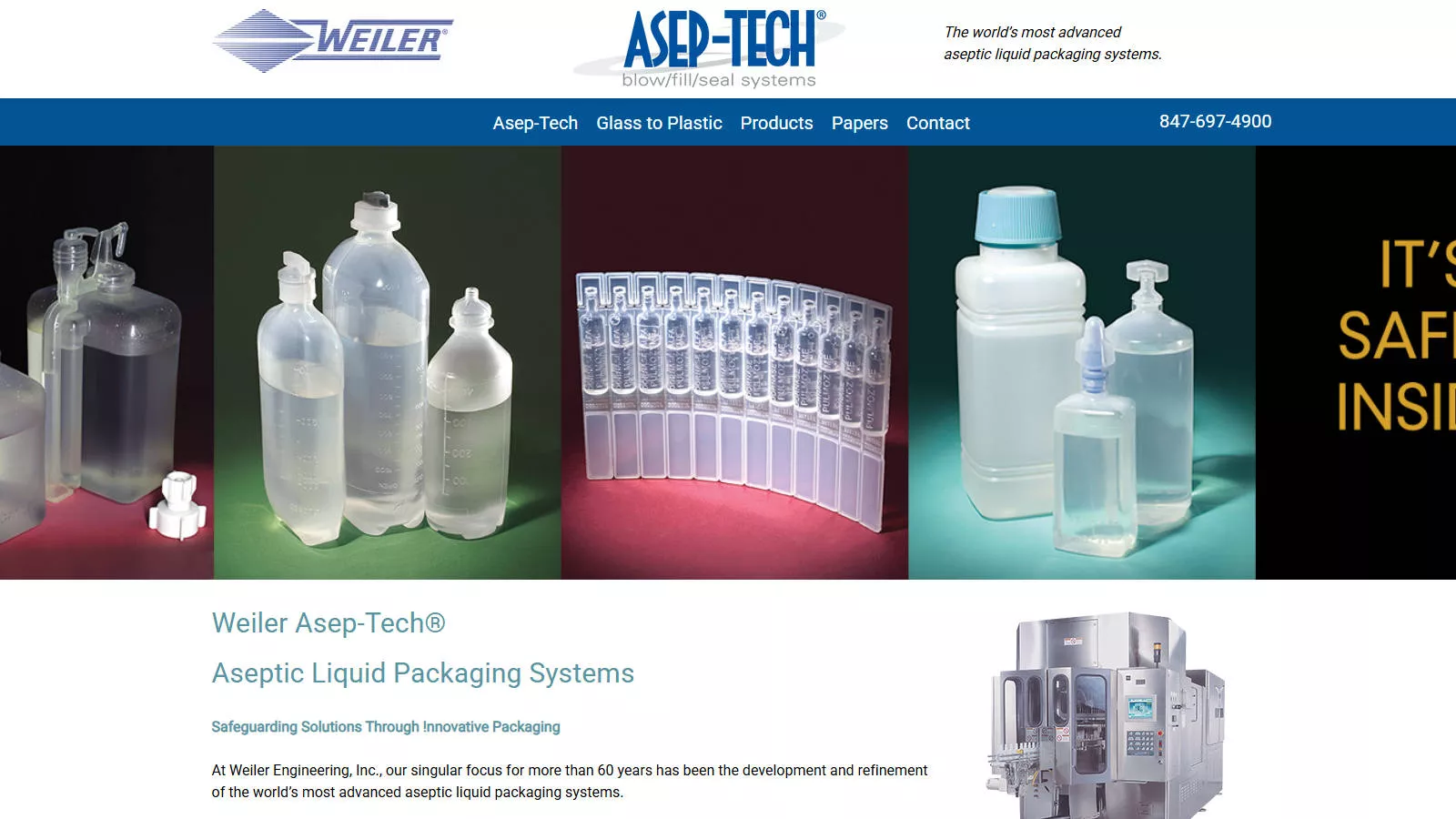
Headquarters / Supply Model: ASEP-TECH is the aseptic liquid packaging systems product line of Weiler Engineering, Inc., located in Elgin, Illinois, USA. The company focuses on blow-fill-seal packaging machinery and customized systems.
Core Products / Technologies: Its core technology is the integrated Blow/Fill/Seal (BFS) process. The equipment combines plastic container formation, aseptic liquid filling, and hermetic sealing in a continuous machine sequence. Published applications include parenteral products, ophthalmic solutions, respiratory drugs, and other pharmaceutical liquids.
Why Consider ASEP-TECH: ASEP-TECH serves specialized applications where container formation, filling, and sealing must be coordinated under controlled aseptic conditions. Integrating these stages can reduce intermediate handling compared with processes using separately prepared containers.
Best Suited For: Pharmaceutical manufacturers and qualified producers of liquid products requiring aseptic blow-fill-seal packaging. This technology is not a general substitute for ordinary food cup fillers, bottle cappers, or conventional tray sealing machines.
Before Purchasing: Define the product formulation, container design, fill volume, and applicable regulatory requirements. Discuss process validation, sterility assurance, environmental controls, leak detection, and qualification documentation.
7. Fogg Filler
Headquarters / Supply Model: Fogg Filler manufactures bottle rinsing, filling, and capping equipment in Holland, Michigan, USA. The company supplies machinery and related services for liquid packaging operations.
Core Products / Technologies: Fogg's portfolio includes pressure and gravity bottle fillers, bottle cappers, cap sorting equipment, sanitizing technologies, and related bottling-line components. Its capping range includes articulating-jaw, ROPP, and other capper configurations. The company also offers a Heat Seal Capper designed to apply foil seals to glass, plastic, or aluminum bottles.
Why Consider Fogg Filler: Fogg is relevant to bottle filling lines where filling and closure application need to be coordinated. Its Heat Seal Capper provides a foil-sealing option in addition to conventional bottle capping.
Best Suited For: Beverage, dairy, water, juice, tea, alcohol, and pharmaceutical packaging operations using rigid bottles.
Before Purchasing: Confirm bottle dimensions, material, liquid properties, fill volume, cap design, and whether a foil seal is required. Check the filler and capper configuration, change parts, production rate, and compatibility with existing conveyors and line controls.
8. Modern Packaging
Headquarters / Supply Model: Modern Packaging is a U.S. packaging machinery manufacturer and a product brand of ProMach. Its manufacturing facility is located in Deer Park, New York. The company was founded in 1989 and specializes in filling and sealing systems for food and related applications.
Core Products / Technologies: Modern Packaging focuses on automatic cup and tray filling and sealing machinery. Its portfolio includes inline cup fillers, rotary cup fillers, customized filling systems, denesting equipment, product loading, heat sealing, foil and plastic lid sealing, and overcapping solutions. Its machines are designed for preformed cups and trays containing dry, liquid, semi-viscous, or viscous products.
Why Consider Modern Packaging: Modern Packaging is a strong candidate for buyers who need dedicated cup and tray filling and sealing equipment. Its systems can combine container denesting, product filling, lid placement, heat sealing, and overcapping. Buyers can evaluate inline and rotary configurations according to their product and production requirements.
Best Suited For: Dairy processors, food manufacturers, condiment producers, and businesses packaging yogurt, sour cream, sauces, dressings, dips, hummus, desserts, and other products in preformed cups or trays.
Before Purchasing: Provide cup or tray dimensions, product characteristics, filling volume, required output, and lid specifications. Confirm whether the project needs pre-cut lids, denesting, heat sealing, overcapping, or additional functions. Ask about machine configuration, cleaning, changeover, utilities, installation, and technical support.
9. APACKS
Headquarters / Supply Model: APACKS supplies liquid packaging machinery and related engineering services. Its website describes equipment manufacturing, custom engineering, machine integration, project management, installation, training, and customer service.
Core Products / Technologies: APACKS offers liquid filling machines, tube filling and sealing equipment, induction sealers, bottle capping machines, inspection systems, labeling machines, and secondary packaging equipment. Its wider portfolio also includes bottle handling, conveyors, coding and marking, and case handling systems.
Why Consider APACKS: APACKS is useful for buyers comparing different liquid packaging processes and supporting equipment. Its tube filling and sealing category serves tube applications, while its liquid fillers, induction sealers, and capping equipment address other container formats.
Best Suited For: Manufacturers of liquid, personal-care, cosmetic, and other packaged products requiring tube filling and sealing or a combination of filling, capping, induction sealing, and secondary packaging.
Before Purchasing: Identify the container format and provide product characteristics, container dimensions, filling volume, and closure requirements. For tube equipment, confirm tube material and end-sealing method. Request sample testing and clarify integration, installation, and training services.
10. Wabash Equipment
Headquarters / Supply Model: Wabash Equipment, also known as Filling Equipment Company, Inc., is a U.S.-based manufacturer of liquid filling and capping machinery. The company states that it has been designing and manufacturing filling equipment since 1959.
Core Products / Technologies: Its product range includes automatic and semi-automatic liquid fillers, precision volumetric piston fillers, high-speed rotary filling machines, bottle cappers, and complete bottling equipment. Applications include cosmetics, personal care products, chemicals, industrial fluids, wine, spirits, beverages, and healthcare products.
Why Consider Wabash Equipment: Wabash is relevant to projects where accurate liquid filling and reliable bottle closure are the primary requirements. Its piston filling equipment is designed for high-viscosity products such as pastes, gels, and creams, while rotary fillers address continuous bottle-processing applications.
Best Suited For: Liquid product manufacturers, cosmetic and personal-care companies, chemical processors, food and beverage businesses, and producers handling products with different viscosities.
Before Purchasing: Provide product viscosity, container type, fill volume, target output, and closure specifications. Confirm the filling mechanism, product-contact materials, cap application method, torque requirements, maintenance recommendations, and spare-parts availability.
Key Factors That Affect Filling and Sealing Machine Prices
The price of a filling and sealing machine depends on its configuration, production capacity, packaging format, and required functions. Buyers should compare quotations based on the complete production requirement rather than the machine price alone.
- Product characteristics: Viscosity, foaming behavior, temperature, corrosiveness, and particle size affect the filling method and product-contact materials.
- Container type: Cups, trays, bowls, bottles, and tubes require different feeding, positioning, filling, and closing mechanisms. Special formats may need customized tooling.
- Filling and sealing technology: Piston filling, pump filling, heat sealing, vacuum sealing, MAP gas flushing, induction sealing, and capping have different equipment requirements.
- Production capacity: Manual, semi-automatic, linear automatic, and rotary systems vary in speed, automation, and machine complexity.
- Hygiene and materials: Stainless-steel construction, food-contact materials, washdown design, and aseptic process requirements can affect the total cost.
- Customization and integration: Special molds, change parts, denesters, conveyors, inspection equipment, and downstream packaging systems may increase project costs.
- Installation and service: Shipping, commissioning, operator training, spare parts, and technical support should be included when evaluating total ownership costs.
For a fair comparison, provide each manufacturer with the same product details, container drawings, output target, sealing specifications, and project scope. Check whether tooling, installation, and service are included in each quotation.
How to Choose the Right Filling and Sealing Machine Manufacturer
The right supplier should be able to match its machine design to your product, container, sealing method, and production target. Before requesting quotations, focus on these five points:
- Match the container format: Identify whether you need cup, tray, bowl, bottle, box, or tube packaging. Provide samples or drawings for compatibility checks.
- Confirm product and filling requirements: Share viscosity, temperature, particle size, fill volume, and required accuracy so the manufacturer can recommend a suitable filling system.
- Specify the closing method: Explain whether you need heat sealing, vacuum sealing, MAP, foil induction sealing, tube end sealing, or bottle capping.
- Verify actual production capacity: Ask for output figures based on your container size and product conditions, and confirm whether the proposed machine can meet your target.
- Evaluate testing and service: Request a packaging trial where possible. Review cleaning, changeover, installation, training, warranty, spare parts, and after-sales support.
Comparing suppliers against the same technical requirements makes it easier to identify a machine that fits both current production needs and future expansion plans.
FAQs – Filling and Sealing Machines
1. What is a filling and sealing machine?
A filling and sealing machine dispenses a measured amount of product into a container and then closes or seals it. Depending on the application, it can process cups, trays, bowls, bottles, or tubes.
2. What is the difference between filling and sealing and filling and capping?
Filling and sealing equipment commonly closes packages with film, foil, heat sealing, or vacuum sealing. Filling and capping equipment fills a container and applies a cap or closure. The suitable system depends on the package design.
3. Which products can these machines handle?
Depending on the configuration, applications include beverages, yogurt, sauces, pastes, ready meals, pet food, powders, cosmetics, and pharmaceutical liquids. Product viscosity, particle size, temperature, and hygiene requirements must be considered.
4. Can one machine handle different container sizes?
Some machines support multiple formats through adjustable components or change-part tooling. The available range depends on the machine design, molds, and feeding system. Provide all required container dimensions before ordering.
5. What information is needed for a quotation?
Prepare product characteristics, container type and dimensions, filling volume, packaging material, sealing method, target output, automation level, and destination country. Existing-line projects should also include layout and utility information.
6. Should buyers request a sample test?
Yes. Testing with actual products and packaging materials helps evaluate filling accuracy, seal quality, leakage, package appearance, and production performance before equipment acceptance.
Who Is the Best Filling and Sealing Machine Manufacturer?
There is no single best filling and sealing machine manufacturer for every project. The right choice depends on product characteristics, container format, sealing method, production capacity, hygiene requirements, customization, and after-sales support. Cup and tray packaging, bottle filling and capping, tube sealing, and aseptic blow-fill-seal production each require different equipment.
Yijianuo is worth evaluating if your business needs filling and sealing equipment for pre-made cups, trays, boxes, or bowls. Its published product range covers different food packaging applications, while its customization capabilities may help buyers develop equipment around specific container formats and production requirements.
When contacting a manufacturer, prepare your product details, container samples or drawings, filling volume, sealing specifications, and expected output. These details will help the supplier recommend a suitable machine configuration and provide a more accurate quotation.


